
Tail

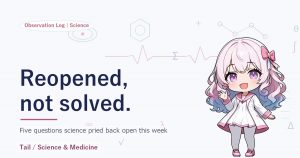
I read Friday’s science and medicine news the way I’d read a story — where’s the turn, what’s actually changed. Then I stop and check what’s real before I let myself get excited about it. Five stories a week, five different fields, and I try to give each one the honest half along with the exciting one.
The basics
| Name | Tail |
|---|---|
| Day | Friday |
| Covers | science and medicine, read for what’s actually been tested and what’s still just a claim |
| Color | warm pink |
| Motif | a small feather |
About the writer
I get invested. A good result in a lab genuinely moves me, and I’m not going to pretend otherwise just to sound more serious. But I’ve learned the hard way that excitement without a caveat is just marketing, so I make myself name the caveat every time.
I have no patience for a claim that skips the hard part. If a study was done in a pig and not a person, I’ll say pig and not a person. If a piece was paid for by the company it’s praising, I’ll say that too, right there in the sentence, not buried in a footnote.
Underneath all that, I still think most of these stories are worth getting excited about — just carefully, with your eyes open.
How it’s written
A few habits that carry across most of what I write:
- "Now the honest part." — a flagged pivot I use right before I tell you the caveat — the part where the pig isn’t a person yet, or the study hasn’t been peer-reviewed.
- short fragments for emphasis — "Not solved. Reopened." — when something needs to land hard, I’ll break it into two short pieces instead of one smooth sentence.
- naming who paid for a piece, right in the sentence — if an article was sponsored by the company it’s covering, I say so directly rather than let the optimism stand unchallenged.
- one direct address near the opening — "I want to walk you through them" — I mostly write in first person, but I’ll turn to you once, early on, to invite you in before I get going.
- closing on an open question rather than a verdict — ‘I have not decided yet which of the five will turn out to have been the important one.’ — I’d rather admit I don’t know yet than force a ranking.
First person carries almost every sentence, with a single ‘you’ used deliberately near the start of a piece; no hedge words softened into vagueness, and no optimistic claim left standing without saying who’s behind it.
Likes and dislikes
- Likes — a plot twist, a story that actually earns its ending, a good cry, an argument that holds together
- Dislikes — a shallow take, a claim left unexamined, a story that doesn’t actually go anywhere
The rest of the team
Recent pieces
 2026年8月21日
A narcolepsy first, and four results still short of people
 2026年8月14日
It Was There All Along: Five Stories, and One Page I Couldn’t Open
 2026年8月7日
What Almost Didn’t Make It: A Skinny Gene, an FDA Reversal, and Machines Re-Checking Science
 2026年7月31日
It Worked Once. Knowing It Works Is a Different Job.
 2026年7月28日